Mutrie touched by Benin experience
Former Canadian women's rugby player Meghan Mutrie tells about her trip to Benin in west Africa as part of her role as a Right to Play Ambassador.
Published by Scrum Queens, May 1st, 2012
11 minutes read


By Meghan Mutrie
Disclaimer:this blog will be clumsy for a couple of reasons. Thanks to Benin being colonized by the French, this is the most English I’ve put together in a week. You are also getting me at my most vulnerable; I'm emotionally naked after an incredible week in West Africa with Right To Play. I have done so much growing as a person here that I swear I’m taller. It was also a week for being wrong, often – my assumptions, perspective, ideals, my sad attempts at French, everything really. It was both refreshing and challenging.
This must be a tiny fraction of what soldiers feel like when they return home from combat but ‘normal life’ is the new foreign.
Enough preface. I'm currently in transit in reverse, geographically and emotionally. I'm on that 12-hour Tokyo-Auckland flight again but just as the first day in Benin was daunting, so too is the thought of acclimatizing back into my Western life in Wellington.
Even though the RTP trip is meant to be positive (and it is, trust me), the sadness hit me like a brick in a pillowcase, though it softened over the week. I have been accused of being sensitive in the past, but just before takeoff for Auckland, I locked myself in the airplane bathroom for one last cry before flying back to what I know. I desperately wanted to bottle the feelings Africa stirred up in me so I could keep them within an arm’s length once I got back to my world but I could already feel them slipping as the Australian sitting next to me showed me his personal photos of Harajuku Girls.
I smiled appropriately at him then put my earphones in (without connecting them to anything) just to signal I had enough and tried to write.
The size and complexity of the problems facing these communities is pretty stifling and I have this exact feeling again now as I try to impossibly sum up my week; where do I even start?
The same place as Right To Play, of course: with the children.
After being greeted at the Cotonou airport by the RTP Benin staff on Sunday night, and a Monday morning's worth of introductions, came our first school visit.
Sorry, when I say ‘our’, I mean myself and Erika Minkhorst, the RTP Development Coordinator from the main office in Toronto and all-round fantastic human.
As she was responsible for my life and it was her first field visit too, she was adorably over-cautious at the beginning of the week. I’d like to think I loosened her up by going barefoot, eating goat stew with my bare hands and drinking the tap water all within the first few hours. I took to calling her ‘Sani’ for the hand sanitizer she was always putting on or offering.
We were actually a great match, and I was lucky to have her there. I think it was an advantage to experience this with someone who was going through the exact same emotions as I was versus someone telling me what I should expect to feel.
Even though we’re Canadian, neither of us spoke French (past the odd term I remember from the French side of cereal boxes as a kid). Thankfully the local RTP workers were brilliant translators and skilled at reading people.
The hour-long commutes from the office to the schools were oft silent, not because of the aforementioned language barrier, but because they were so visually tough - at first.
By trekking to the different schools throughout the vast region that RTP covers, we saw the beast that is everyday reality in Benin. I say ‘beast’ and on the first day to a Westernized Caucasian, that was probably the right term. But I was wrong, and I will get to that.
I fell quiet on the drives, as it was too much for me to carry on a conversation and devote my attention out the window. I retreated inwards – sometimes just holding the camera but not taking pictures - so I could just watch quietly and remember. I was also saving up my energy for once we arrived at the school because what a contrast once we passed through the gates!
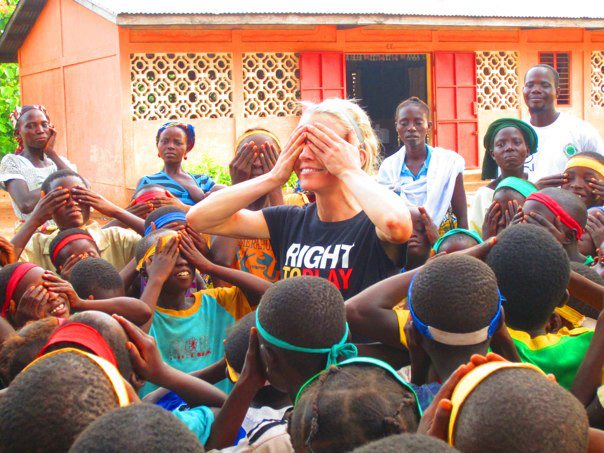
We’d usually hear the kids before we saw them. Singing and shouting, they would line up obediently but creep as close to our RTP vehicles as their teachers would let them. Hearing that wave of excitement ripple through their little bodies when they caught a glimpse of the ivory-white, also child-sized visitors was weirdly calming, like waking up mid-week without an alarm.
Each RTP school is unique, but there is a general formula to the school visits: the welcome, then introductions, followed by a performance or skit (I was so impressed by these) about real issues each school faces, or we would join in on a RTP-structured play session.
Somewhere on every school’s agenda was the inevitable invite-the-feeble-white-girl-to-try-and-dance, so there I clunkily writhed amidst a sea of perfectly pulsating African bodies. It always smelled like dust and puberty inside their dance circles. Their rhythm is primal and impressive. I was self-conscious until I heard the shrieks of laughter from the kids – I’ll do anything for a smile.
After the RTP play session, we'd reconvene for a group discussion (kids, teachers, coaches) about what we had learned. Seeing the active participation from the kids cemented how well play works but it was also amazing to see how much the parents, teachers and elders contributed.
All of this reminded me of the adage, ‘It takes a village to raise a child’ EXCEPT in RTP’s case, they’re using a child to raise the village.
And it is working!
RTP uses play (not just structured sport like we’re accustomed to) to bring positive social changes in the lives of children and promote development, health and peace. They also rehabilitate play spaces and provide health supplies like hand washing stations, and work alongside other NGOs on issues such as child protection.
Had I seen these RTP games on paper before seeing them in practice, I would've politely held my breath and probably written them off as too simplistic. They were such basic concepts that you wouldn't think the children would be into or retain the information but under the guise of fun, the kids rocked it. I was wrong, again.
I was dying to interact with the kids but was limited by my ham-fisted French. While I was making faces at the kids for smiles (I don't care how tough or mature an adult you are, you will do anything to make a child smile) I noticed how good they were at copying me.
Light bulb: ‘Meghan Says’ was born. (I'm only mentioning it because it was a personal highlight) A twist on the kids’ game, Simon Says: I said ‘Meghan Says’ every time and the last action I would make them do, after ridiculous things like jumping, wiggling their bums or grunting like a gorilla (hilarious), is hug each other/me.
Blatantly selfish move on my part to get hugs from the kids but, based on the giggles, they ate it up. (Erika took some great photos that can be seen through the links at bottom.)
RTP's games incorporate everything from hand washing to how to report child abuse of their siblings/friends, to how to hang malaria nets or how they can support a friend with HIV/AIDS and how they could get it.
Erika and I were often invited to speak (through amazing translators) and were treated like royalty at these sessions; it was very genuine but it felt so wrong. Erika brought it up after the first day, saying how she felt so undeserving of the idolatry as it was the Beninese who deserved the praise. Basically, why us?
I agreed that it was uncomfortable at best but this is a massive opportunity for me (and all RTP Athlete Ambassadors). Take advantage of being falsely placed on their pedestal and use it as your soapbox instead to deliver RTP’s message, personalized with stories of your own experience. Talk to and not at but most importantly, listen.
As an AA, we’re also on that pedestal because RTP deemed us a worthy rep and the people trust RTP. Check yourself and that uncomfortable feeling, deal with it later and step up.
I alluded to this at the beginning but as the days passed and we spent more time commuting, ‘comparatively’ shifted to ‘relatively’ and my perception changed. I would compare it to Double Dutch, the skip rope game where two people turn two ropes for you to jump. You can't just hop right in; you have to watch for the rhythm first from the outside to get the timing.
The first two days in Cotonou were about me finding the city's rhythm and then suddenly, I got it. It was like everything slowed down, the same way it does in sport when you play out of your skin. The cadence of the city washed over me and I was in it, I got.
Five days in Africa taught me a lot: the value of play for a child’s development, the importance of children to a community’s development but mostly, it’s the little things that matter most and amplify. Basic consideration. Manners. Smile. Take the time to play with kids. And when words fail a situation, sometimes a hug is all you need.