Oceania 15s kicks off on Friday
The third and largest Oceania test championship kicks off this weekend in Fiji, who will defend their Oceania Rugby Championship title against three Pacific island rivals team from this weekend at Churchill Park, Lautoka.
Published by John Birch, November 13th, 2018
11 minutes read
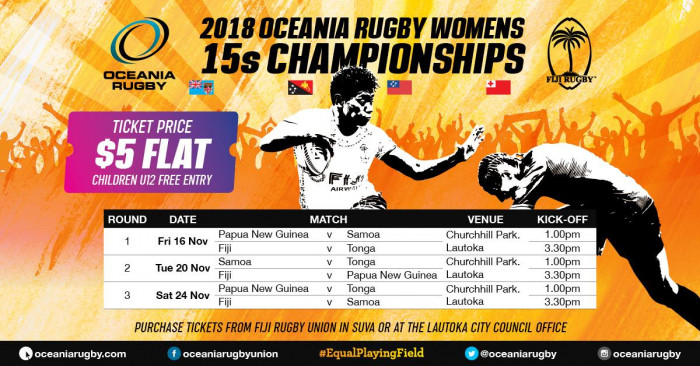


Fiji, Samoa, Tonga and Papua New Guinea will compete in round robin matches in pursuit of only the third Pacific title.
The only previous tournament took place in 2006 and in 2016.
The2006 tournament, in Tonga, was won by Samoa who beat both Fiji and the hosts in a three-team competition, with Fiji finishing as runners-up. Tonga has not played any test rugby since so this weekend sees their return to the field after 12 years away,
The competition was revived in 2016 as a World Cup qualifier, but was decided by asingle matchbetween Fiji and Papua New Guinea after Samoa’s entry was now allowed by World Rugby due to concerns about their domestic women’s rugby. This was Papua’s first test, and Fiji’s first test since 2006. Fiji won 37-10. Fiji went on to play against Japan and Hong Kong for a place in the 2017 World Cup, but lost both games. Neither has played since.
Samoa have been by far the most active Pacific island team, having appeared at three World Cups between 2002 and 2014, with wins recorded over teams such as Ireland, Wales, Kazakhstan and South Africa in their 23-test history. However, they have not played since 2014.
As a result this is a massively unpredictable event, with small advantages – such as the Fiji Airways sponsorship of the Fijiana – being significant.
“The tournament will showcase the emerging strength of international women’s rugby”, says Fiji CEO John O’Connor, “and provide a platform for our Fiji Airways Fijiana to work towards the 2021 World Rugby Women’s World Cup. To have four teams from across the Pacific here in Fiji, we hope will encourage more women and girls to pick up the ball and start playing rugby.”
Samoa – the “Manu Sina” – may have the greatest test history in the region, but it will count for little. They finished 11th at the 2014 World Cup beating only Kazakhstan and head coach Ramsey Tomokino said after four years in the international wilderness this is a new beginning for the Manu Sina. The squad that includes 23 potential test debutants.
"For us it's a rebuild, it's a restart, a reset/refresh”, says head coach Ramsey Tomokino.
Potentially Samoa could have a world class squad, but suffer from similar problems to the men’s teams. Most Samoan-qualified players live and work in Australia or New Zealand, and accepting a place in the Samoan squad effectively ends hopes of playing professional or semi-pro rugby with the Ferns or Australian squads.
“Obviously we could have probably picked the majority of this team out of the Farah Palmer Cup [in New Zealand]”, he says, “but being a New Zealand Samoan or Australian Samoan you are blessed with being able to have two bites at the cherry in terms of trying to get to an international tournament. We've got to allow the girls to have the opportunity to be able to do that but we love it when those that say 'Hey look, I'm ready to represent Samoa and that's what I want to do'."
In addition, players are forced to choose between 7s and 15s, and many are choosing the former. One effect of this is that are no Samoan-based players in the 26-strong squad, with 21 playing their rugby in New Zealand and the other five in Australia.
"A lot of the key girls that probably might have been available are playing in the [Oceania] Sevens competition and as the game grows and more opportunity [comes] then we will be inclusive of local girls in Samoa and obviously the best ones out there," he said.
"There's certainly some good girls there but, like I said, they'll be involved in the sevens and I've got no doubt in my mind there will be people saying 'where's our local girls?' - as we always do - but at this stage it's just we need to get a team out there.
"We need to get runs on the board and we need to put our best foot forward and once we can show we can do this then a whole lot of opportunities are going to come."
Only three players in the squad have prior experience with the Manu Sina fifteen-a-side team: Forty-one-year-old Lorina Papali'i, who featured at the 2002 and 2006 World Cups, while Rita Tau and Cynthia Apineru took part in the 2014 event.
Papali'i, Aieshaleigh Smalley and Sui Pauaraiasa were also a part of the New Zealand Warriors inaugural season in the National Rugby League Women's Premiership, with the Kiwi Ferns internationals switching codes.
Ramsey Tomokino said with the Oceania tournament set to become an annual affair and promising talks about involving teams from Asia in the future it's an exciting time for the women's game.
"It's a massive step forward and kudos to Oceania Rugby and obviously World Rugby for wanting to drive the women's programme," he said.
"We've gone from zero test matches and we're going to have three in the space of (nine) days that we're in Fiji for and to put that into perspective one of our most capped Manu Sina players, who's not in this team, has played ten test matches over a span of a number of years and some of these ladies are going to get the opportunity to do three test matches in one year."
Papua New Guinea – the “Palais” – has a successful 7s tournament last weekend, finishing fourth behind the regions three World Series teams, and it is hoped this will rub off onto their 15s side.
Papua New Guinea’s squad includes several players with sevens experience, lead by Joanne Lagona who played professional sevens in Japan in 2017.
The sevens success is a two-edged sword, however, as 15s is the junior partner with most funding and sponsorship directed towards the sevens program. Oceania Rugby provides for airfares, accommodation and meals, but the PNGRFU has to cover for its own uniforms, walk-on gear, incidentals and other associated costs for the tournament, which also last two weeks instead of just a weekend. It is a tough task for a small union where rugby league is the dominant sport.
Despite this, PNG needed to put its hand up to participate to showcase to raise their profile in Oceania fold and contribute meaningfully to the development of women’s rugby in the region.
“As this championship will be an annual event we have to show that we are proactive and committed to the women’s rugby programme in Oceania”, says Onshore Team Manager Fiona Speedy.
“Next year, PNG should have a properly constituted National Selection Panel and a Women’s 15s Provincial Championship to select the best possible female players from around PNG and abroad, to represent our country. So a player pathway is being created for women’s rugby in both the 7s and 15s versions of this global sport.”
The appearance of a Tongan team is a remarkable step coming only months after attempts were made to ban girls from playing rugby at school. The backlash against that move – which was quickly rescinded after worldwide headlines – and may have given the women’s game a higher profile in the islands than perhaps ever before. As with Samoa, many of the squad will have experience of playing in New Zealand and Australia. The team also features Ivamere Fatafehi, whose mother is from Nadroga in Fiji.
Six New Zealand-based players flew into the country to be part of the Tonga women’s team: Vai’inga Moimoi (captain), Shirley Mailangi, Ruby Tangulu, Doria Taufateau, Meleane Fifita and Lita Fuikefu.
Captain Moimoi said they have a plans: “We will be using our forwards more often. We expect a lot from Fiji because they are very strong both in attack and defence,” she said.“They played a lot of sevens rugby and we have learned a lot from how they play and we have a chance to beat them. We have a young side ready for the physical battle.”
The three flyers in the side are Pesalini Heehau, Lita Fuikefu and Ilaisane Fanguna.
“It has been good so far and it has been awhile for some of the women to play 15s again and it is new to them,”she said.
Squads
Fiji:1 Lailanie Burnes; 2 Litia Marama; 3 Nioni Nai Raiqisa; 4 Laisa Taga; 5 Torika Semo; 6 Jiowana Sauto; 7 Esita Kotoisuva; 8 Lavenia Tinai; 9 Ana Maria Roqica; 10 Tokasa Seniyasi; 12 Mereani Moceituba; 13 Rusila Nagasau (c); 14 Salote Vakaturi; 15 Timaima Ravisa; 16 Makelesi Lalabalavu; 18 Tuliana Rokosugu Ragadi; 19 Karalaini Naisewa; 21 Eleina McDonald; 22 Taraivini Adiraba; 23 Salote Halofaki; 24 Luisa Basei Tisolo; 26 Mere Moto; 27 Makereta Tunidau
Papua New Guinea:Lydia Korikai, Robyn Ravu, Lorraine Pomat, Melissa Thomas, Letitia Gabi, Jane Buku, Christine Wanma, Geua Larry, Shellane Kopi, Norah Wartovo, Hannah Singut, Mary Lavari, Margaret Naua, Rose Eva, Bibiana Paloa , Kymlie Rapilla, Darusila Oki, Taiva Lavai, Zafira Pangkatana, Helen Abau, Debbie Kaore, Vero Waula, Fatima Rama, Jill Yalon, Mala Mark, Joanne Lagona and Janina Nightingale.
Samoa: Aiesha Smalley, Alafou Fatu Sataoa, Billy-Jean Tuavale Ale, Brittany Le'aua'nae, Brooke Tauaneai, Cynthia Apineru, Inga Timani, Jacqui Aiono, Jennifer Simati, Josephine Falesita, Lorina Papalii, Luisa Gago, Lumepa Maiava, Marilyn Live, Mary-Lee Sa'u, Moega Wright, Nina Foaese, Osooso Feaunati, Rita Tau, Ruth Vae, Sieni Mose, Sieni Tusi Misi, Sui Pauaraisa, Taylah Hodson-Tomokino, Tuiala To'o, Viviena Hingano
Tonga:Mele Akuila, Na'a Nanivi,Ae Tau Kaufusi, Salome Pahulu, Tolofi Takitaki, Nina Alofaki, Daniel Kivalu, Malia Pale, Ruby Tangulu, `llaisaane Fanguna, Vikafaiana Lelea, Fonoifua Paula, Doris Taufateau, Meleane Fifita, Shirley Mailangi, Ema Potaufa, Taumafa Toko, Lesieli Fislau, Patsy Manuofetoa, Judith Pita, Fehoko Tu'ivai, Lita Fuikefu, Leslie Mapa, Luisa Pita, Susana Tupou, Uheina Hala'api'api, Mo'unga Mohetau, Fili Sau, Sharon Vailea, Pasalini Haahau, Va'inga Lesieli Moimoi, Lanuola Takau