Mignot: “Its a big challenge, but we’ll meet it”
Gaelle Mignot’s takeover of the French captaincy last year was as unexpected as it was unplanned. However, she led her team to not only their first Grand Slam for nearly a decade, but also their best result in the World Cup since 2006. We spoke to her this week about the challenges ahead in 2015.
Published by John Birch, February 3rd, 2015
6 minute read
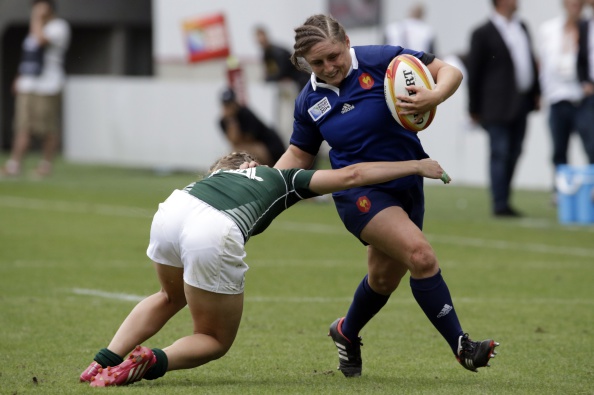


At the Six Nations launch in London, Mignot was positive about the French challenge this year.
“There have been many changes to the squad since August. Our objective is to begin to prepare for the next World Cup in three years. We have had a great many new players and new faces in pre-tournament training, and the squad now includes nine players from Armelle Auclair [Elite 2nd division], which is good because the standard of play in the Armellle Auclair is at an increasingly high level. There are players in the division who have already played for France at sevens or U20s so they deserve their chance to play for test team."
Mignot said that most of the new players in the squad have played for France at U20s level and are now moving into the senior team.
“Caroline Boujard (21) from Perpignan, for example, is a dynamic and effective full back who goes through defences in a remarkable way, as my own club discovered earlier this month. Carla Neisen from Blagnac - who scored against us last weekend - is a true modern outside centre, and still very young (19) – the youngest player in the squad.
“Camille Cabalou is a fly-half who plays in the second division for Bayonne. Also only 21 she has excellent game vision, tackles hard and tirelessly, and will bring some real energy and spirit to the team.
“Wendy Divoux is another promising young player, a hooker, who will progress a long way with this experience. She’s very good at the breakdown. Wendy was in the U20s recently but has been to camps with the main team since before the World cup.
“Céline Ferer is a tall second or back row from Bayonne who is quite something when it comes to the line out.
“Our young and up-and-coming scrumhalf is Marie Menanteau, who brings the vitality and dynamism of her youth along with great game vision.
“And finally there is Pauline Rayssac, who has played sevens for France, and is a back row (normally openside flanker) for Montpellier. A big tackler, she is fast and covers a lot of ground.
Mignot is not worried that the improvements in the French side in recent years is adding to any pressure.
"I do not think that our recent performances have created any more pressure than usual, but we want to prove that we can do well and continue to develop the good image of rugby that was started this summer. We are followed by so many people - and hopefully the results will also follow.
“It will be very very difficult to win the title again - we’re going to go to the homes of England and Ireland. It’s a big challenge, even more difficult than last year, but we’re going to be there to meet it.
We also asked Gaelle about her thoughts regarding the domestic game in France.
“The size of the recent audiences for club games on television is brilliant – for my game on Sunday there were over 200,000 viewers despite there being mens’ matches on the same time on other channels, so it’s very encouraging for the future. The Top 8 final will be on television, but beyond that for now we hope that television channels will continue to broadcast our matches beyond just the final. And all our home matches of the Six Nations tournament will now be broadcast in France.
“Television does add extra pressure, especially for the younger players who have never experienced it before. Like my team, Montpellier, at Perpignan it is true that our young three quarters did not have a good game. It was their first time on television - but they’ll get used to it.
“It’s difficult to predict who will win the Top 8. it’s a competition which is getting stronger and stronger. Montpellier has the title and everyone wants it, but we are hoping to keep it.
“The move from a Top 10 to a Top 8 has meant there is more rest time for the girls playing for French teams, and especially the sevens team, though whether the quality of games in the league is stronger is hard to say although the teams are maybe closer in strength. But one can’t yet say that the standard is better than it was.
“The reasons for the change were understood and accepted – I remain positive. Obviously the girls that are not going to be in the squad for the Six Nations are not going to be have much play over the next few weeks, but it has been accepted.
“Some clubs like Montpellier and Perpignan are linked to professional men’s clubs, but I am not sure that this gives them an advantage.There’s still a difference between us and the professional setup, with the women’s team being more like an association. It’s one overall club, but with separate two structures within it.”